
Custom Software vs Off-the-Shelf Software: Which is Right for Your Business?
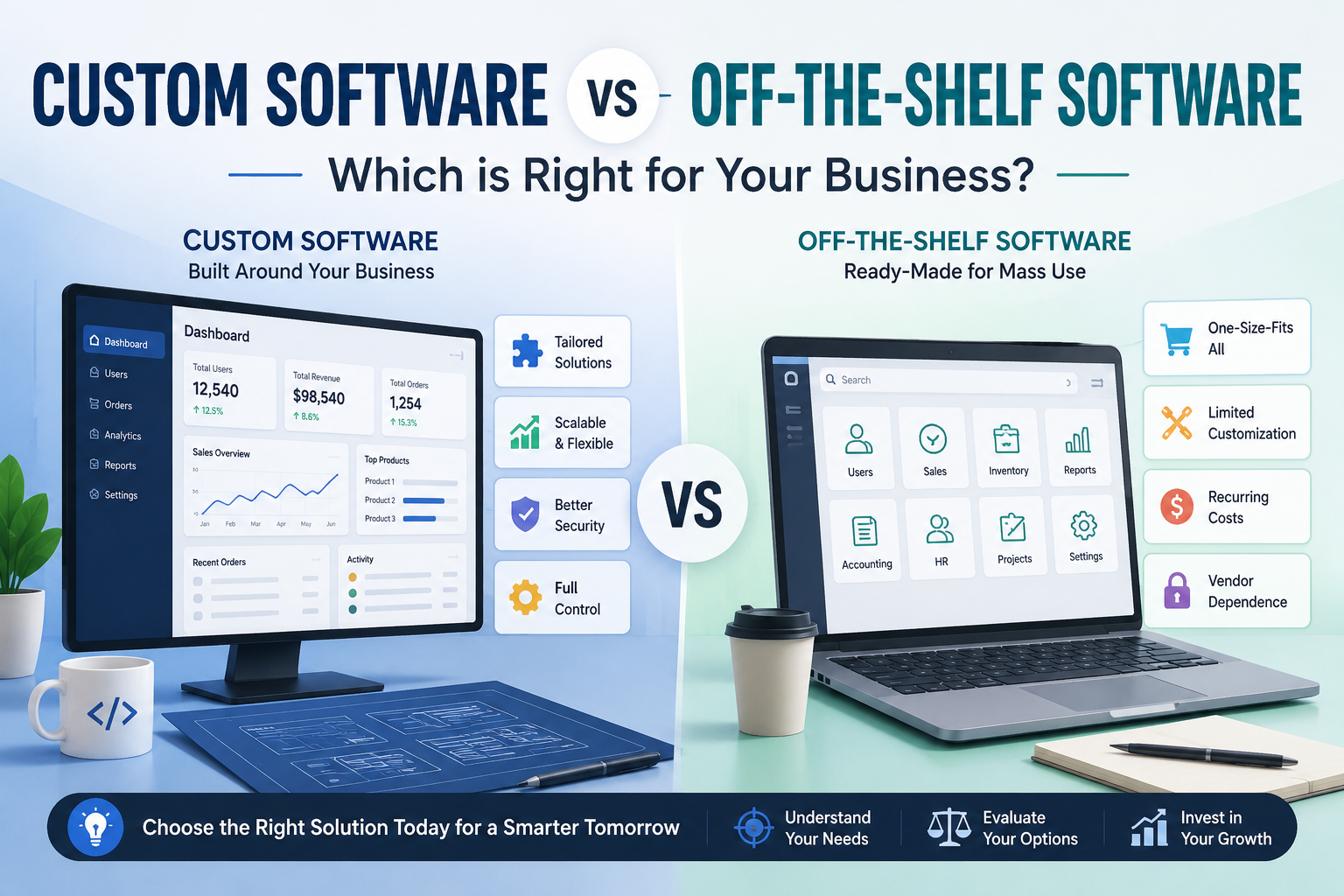
Every business today relies on software to improve efficiency, streamline operations, and deliver better customer experiences. Whether you're managing inventory, tracking sales, handling customer relationships, or automating internal workflows, choosing the right software is one of the most important business decisions you'll make.
However, many business owners face a common question:
Should you invest in custom software or choose an off-the-shelf solution?
The answer depends on your business goals, budget, scalability requirements, and long-term vision. While off-the-shelf software offers convenience and quick deployment, custom software provides flexibility and is built specifically around your business needs.
In this guide, we'll compare custom software and off-the-shelf software, discuss their advantages and limitations, and help you determine which option is the best fit for your organisation.
What Is Custom Software?
Custom software is a solution designed and developed specifically for a business or organisation. Instead of adapting your processes to fit the software, the software is built around your unique workflows, objectives, and operational requirements.
Unlike generic applications, custom software is tailored to solve your specific business challenges.
Examples include:
- Customer Relationship Management (CRM) systems
- Inventory Management Software
- Enterprise Resource Planning (ERP)
- Healthcare Management Systems
- Learning Management Systems (LMS)
- Logistics and Supply Chain Platforms
- Booking and Reservation Systems
What Is Off-the-Shelf Software?
Off-the-shelf software refers to pre-built applications designed for a broad audience. These products are developed to meet common business needs and are available for immediate purchase or subscription.
Popular examples include:
- Microsoft 365
- Salesforce
- Shopify
- QuickBooks
- Slack
- Zoom
- Trello
Key Differences Between Custom Software and Off-the-Shelf Software
| Feature | Custom Software | Off-the-Shelf Software |
|---|---|---|
| Development | Built specifically for your business | Designed for general use |
| Flexibility | Highly customisable | Limited customisation |
| Initial Cost | Higher upfront investment | Lower upfront cost |
| Scalability | Easily scales with business growth | May require upgrades or replacements |
| Integration | Designed to integrate with existing systems | Integration options may be limited |
| Ownership | Full ownership | Vendor-owned |
| Maintenance | Managed by development partner | Managed by software provider |
Benefits of Custom Software
1. Tailored to Your Business Needs
Every business operates differently. Custom software is designed around your workflows rather than forcing your team to adapt to predefined processes.
This results in:
- Improved efficiency
- Better productivity
- Simplified daily operations
- Reduced manual work
2. Better Scalability
As your business grows, your software should grow with it.
Custom software allows you to:
- Add new features
- Support additional users
- Expand into new markets
- Integrate new technologies
3. Improved Security
Cybersecurity is a growing concern for businesses of all sizes.
Since custom software is built specifically for your organisation, it typically has fewer publicly known vulnerabilities than widely used commercial software.
Additional security measures, such as role-based access, data encryption, and compliance features, can also be implemented to meet your industry requirements.
4. Seamless Integration
Many businesses already use multiple systems.
Custom software can integrate with:
- CRM platforms
- Accounting software
- Payment gateways
- ERP systems
- Marketing tools
- Cloud platforms
5. Competitive Advantage
A unique software solution can offer capabilities competitors lack.
Whether it's automating complex workflows, improving customer service, or offering innovative digital experiences, custom software can become a valuable business asset.
Advantages of Off-the-Shelf Software
1. Faster Deployment
One of the biggest advantages of off-the-shelf software is speed.
Most applications can be installed or subscribed to within hours, allowing businesses to start using them immediately.
2. Lower Initial Investment
For startups and small businesses, purchasing a subscription-based software solution is often more affordable than investing in custom development.
This makes it an attractive option for businesses with limited budgets.
3. Proven Reliability
Popular software solutions have been tested by thousands—or even millions—of users.
Most vendors provide:
- Regular updates
- Bug fixes
- Security patches
- Customer support
- Online documentation
4. Large User Community
Established software products often have extensive communities where users can find tutorials, best practices, and troubleshooting advice.
This reduces the learning curve for employees.
Limitations of Off-the-Shelf Software
While off-the-shelf software offers convenience, it also has limitations.
Common challenges include:
- Features you never use
- Missing business-specific functionality
- Ongoing subscription costs
- Vendor dependency
- Limited customisation
- Integration challenges
When Should You Choose Custom Software?
Custom software is ideal if:
- Your business has unique processes.
- You need advanced automation.
- Existing software doesn't meet your requirements.
- Security and compliance are critical.
- You expect significant business growth.
- You want complete ownership of your software.
When Is Off-the-Shelf Software the Better Choice?
Off-the-shelf software works well if:
- You need a solution quickly.
- Your requirements are straightforward.
- Budget is limited.
- Your team is small.
- Standard features meet your operational needs.
Cost Considerations
One of the biggest misconceptions is that custom software is always more expensive.
While the initial investment is typically higher, businesses should consider the total cost of ownership.
Off-the-shelf software often involves recurring subscription fees, additional charges for premium features, user licences, and third-party integrations.
Custom software may require a larger upfront investment, but over time it can reduce operational costs by improving efficiency, eliminating unnecessary subscriptions, and supporting business growth without major limitations.
The right choice depends not only on your current budget but also on your long-term business strategy.
Questions to Ask Before Making a Decision
Before choosing between custom software and an off-the-shelf solution, ask yourself:
- What business problem am I trying to solve?
- Will my software requirements change over time?
- How important is scalability?
- Do I need integration with existing systems?
- What level of customisation is required?
- What's my long-term technology roadmap?
Final Thoughts
There is no one-size-fits-all answer when it comes to choosing business software.
If your organisation requires flexibility, scalability, advanced integrations, and a solution tailored to your operations, custom software is often the best long-term investment.
On the other hand, if you need a reliable solution quickly and your requirements are relatively standard, off-the-shelf software can provide excellent value with minimal setup time.
The most important step is understanding your business needs before making a decision. Working with an experienced software development partner can help you evaluate your requirements and recommend the right solution for both your current goals and future growth.
Whether you're building a new digital platform or modernising existing systems, investing in the right software today can create lasting value for your business tomorrow.
FAQ
1. What is the main difference between custom software and off-the-shelf software?
Custom software is built specifically for your business requirements, while off-the-shelf software is designed for a wide range of users with standard features.
2. Is custom software worth the investment?
Yes, especially for businesses with unique workflows, growth plans, or complex operational requirements. It offers greater flexibility, scalability, and long-term value.
3. Can custom software integrate with existing business systems?
Absolutely. Custom software can be designed to integrate seamlessly with CRMs, ERPs, accounting software, payment gateways, and other business applications.
4. Which option is better for small businesses?
For businesses with basic requirements and limited budgets, off-the-shelf software can be a practical starting point. As the business grows, custom software may become a better long-term solution.
5. How do I know which software solution is right for my business?
Evaluate your business goals, workflows, budget, scalability needs, and integration requirements. Consulting with an experienced software development company can help you make the right decision.